
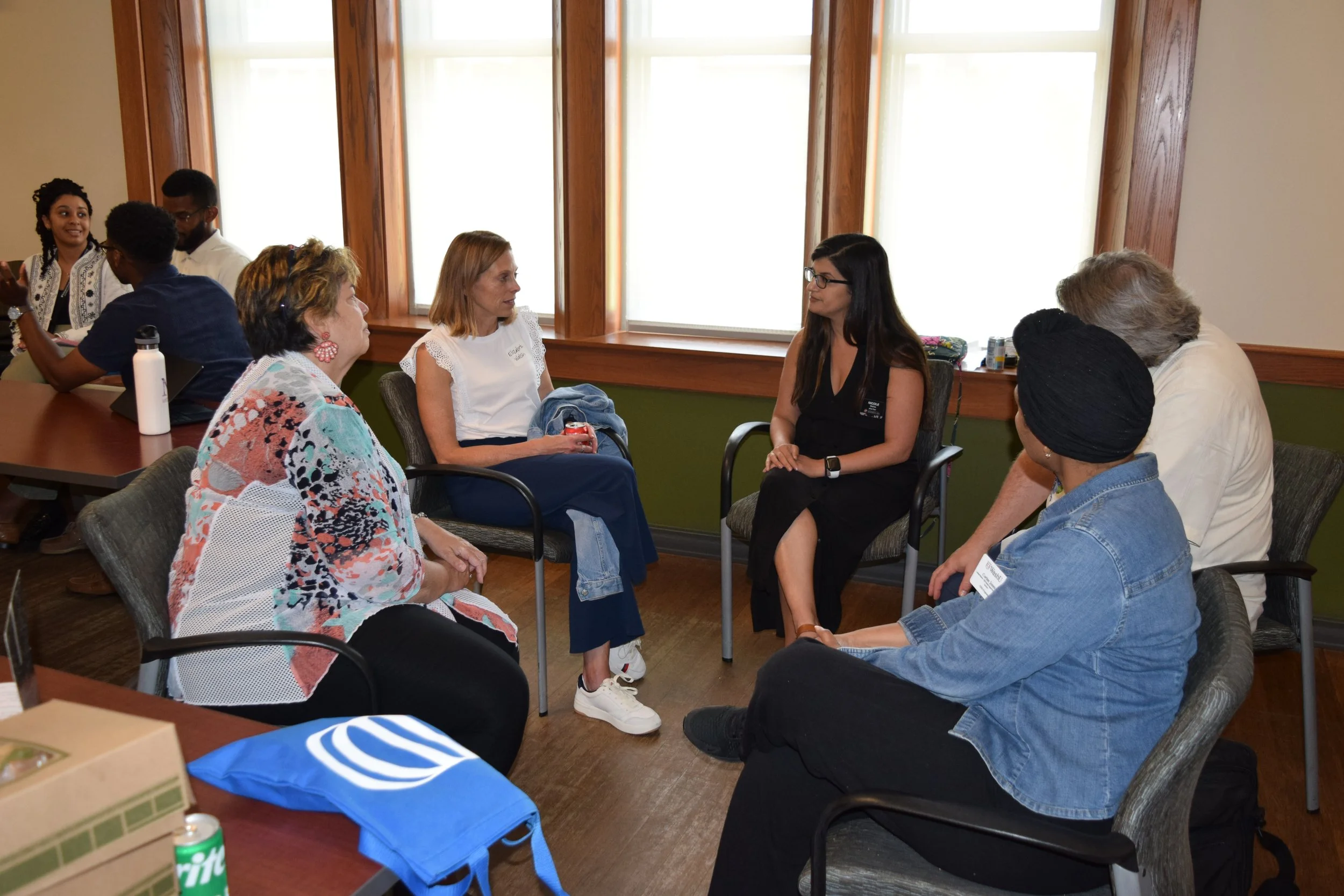
For dialogue practitioners, as well as individuals interested in facilitating or participating in dialogue, this page offers a curated collection of resources to support and inform their work. Drawing from leading scholars and practitioners in the field, it includes research-based articles, practical tools, and accessible materials such as books and podcasts. Collectively, these resources provide both theoretical grounding and applied strategies for fostering meaningful, inclusive, and effective dialogue across differences.
DIALOGUE RESOURCES/HANDOUTS
This collection of practical tools developed through the University of Michigan Program on Intergroup Relations supports dialogue facilitation by offering strategies for listening, navigating conflict, addressing bias, and building shared guidelines.
A collection of resources developed through Meet the Moment — a partner program of the DDNRC through the University of Michigan. This document provides a myriad of resources for facilitating and participating in dialogue in higher education. These resources are derived from community partners and advanced dialogue practitioners.
This initiative provides tools and strategies for facilitating difficult conversations in higher education, helping educators introduce controversial topics while fostering respectful, inclusive dialogue across differences. The toolkit includes access to three handbooks on difficult dialogues.
This resource presents the DDNRC’s established approach to dialogue guidelines, developed through robust practice and expertise in difficult dialogues. It offers a foundational framework for creating shared expectations, fostering respectful engagement, and supporting meaningful conversations across differences.
DDNRC | Strategies for Current Challenges in Dialogue Facilitation
This resource draws on DDNRC expertise to address common challenges in dialogue, such as polarization, rapidly evolving issues, and virtual engagement, offering practical strategies for facilitators. It is especially useful for adapting dialogue practices to complex, real-world contexts while maintaining inclusive, responsive, and effective engagement.
The Imagining America Story Circle Activity Guide
In this quick-guide, Kohl-Arenas (IA Faculty Advisor) offers us an overview of Story Circle history and methods, including a list of shoulds and should-nots when undertaking this activity.
Story Circles: Deep Listening and Bride Building on Issues that Matter, jesikah maria ross
This downloadable guide covers how to host a Story Circle so that you can cultivate listening and bridge-building on housing or other issues in your neighborhood, organization or community. It’s written for public radio stations, community organizations, and other groups who wish to listen to, learn from and build trust with the communities they serve.
RECOMMENDED BOOKS:
This book offers practical strategies for engaging in meaningful conversations across political and social differences, emphasizing curiosity over persuasion. It helps readers understand how assumptions, echo chambers, and personal experiences shape beliefs—and provides tools for asking better questions and building connections through dialogue.
The Case for Cancel Culture: How this Democratic Tool Works to Liberate Us All by Ernest Owens
This book reframes “cancel culture” as a form of democratic expression and accountability, encouraging readers to critically examine power, voice, and social consequences. It can support dialogue by helping participants unpack differing perspectives on free speech, justice, and activism—especially in conversations that may feel polarizing or high-stakes.
The book’s narrative flow follows the course of an academic year. Each chapter addresses a question for each month. The stories and vignettes are meant to complicate your assumptions, introduce arguments from “the other side,” and illustrate how people can recognize good faith disagreements without surrendering their most strongly held beliefs.
Try to Love the Questions: From Debates and Dialogue in Classrooms and Life by Lara Hope Schwartz
Try to Love the Questions gives college students a framework for understanding and practicing dialogue across differences in and out of the classroom. This invaluable guide explores the challenges facing students as they prepare to listen, speak, and learn in a college community and encourages students and faculty alike to consider inclusive, respectful communication as a skill—not as a limitation on freedom.
Drawing on nearly 400 interviews with students, faculty, and staff at 29 higher education institutions across the country, this book provides readers with practical advice on how they can develop and sustain powerful relationship-based learning in their own contexts.
This book redefines love as an active, ethical practice rooted in care, accountability, and justice, challenging dominant cultural narratives that limit how we connect with others. It is a powerful resource for dialogue work, offering a framework for building empathy, trust, and deeper relational engagement—especially in conversations that require vulnerability and mutual understanding.
PODCASTS:
Douglas Ferguson, founder of facilitation academy Voltage Control, speaks with Voltage Control Certification Alumni and other facilitation experts about the remarkable impact they're making. This series is dedicated to helping you navigate the realities of facilitating collaboration, ensuring every session you lead becomes truly transformative.
The skills to engage and bridge differences are needed in higher education and our world today. Kristi Clemens and Dr. Elizabeth Smith share about how the Dartmouth Dialogue Project emerged, how it is structured, and what they have learned through the process thus far. They discuss the key elements of relationship building and empathy, viewing dialogue as a practice, and yearning for and obstacles to dialogue.
This talk with Kelly Maxwell explores how personal identity, lived experience, and critical self-reflection can inform dialogue practice, highlighting the role of intergroup dialogue in examining privilege, navigating institutional tensions, and advancing equity and justice.
This article/podcast is a useful resource for educators and facilitators seeking practical ways to create safer, more productive conversations around polarizing topics in classroom settings.
RESEARCH/ACADEMIC ARTICLES:
Publications on Intergroup Dialogue and Intergroup Relations Education
The research and publications from the University of Michigan’s Program on Intergroup Relations includes scholarly articles, evaluation studies, and reports that examine the theory, implementation, and outcomes of intergroup dialogue. These resources focus on topics like the impact of dialogue on participants’ understanding of social identity and inequality, the development of communication and critical thinking skills, and the effectiveness of dialogue as a tool for promoting equity and social change.
Facilitating change through intergroup dialogue
Through a series of in-depth qualitative interviews and auto-ethnographies, this book explores how former IGD facilitators are applying what they learned to their personal and professional lives three to five years post-college. By exploring facilitators' application of IGD skills, understanding of social justice, and the challenges inherent in this work, Facilitating Change through Intergroup Dialogue offers concrete strategies for supporting undergraduate students in their enduring efforts towards justice.
Intergroup dialogue in higher education: Meaningful learning about social justice.
This foundational text outlines the theory, history, and practice of intergroup dialogue, emphasizing sustained, facilitated engagement across social identity differences to build understanding and advance social justice. It is especially useful for those seeking a deeper, research-based framework for designing and facilitating dialogue in educational settings.
Facilitating change through intergroup dialogue
Through a series of in-depth qualitative interviews and auto-ethnographies, this book explores how former IGD facilitators are applying what they learned to their personal and professional lives three to five years post-college. By exploring facilitators' application of IGD skills, understanding of social justice, and the challenges inherent in this work, Facilitating Change through Intergroup Dialogue offers concrete strategies for supporting undergraduate students in their enduring efforts towards justice.
Intergroup dialogue in higher education: Meaningful learning about social justice
This foundational text outlines the theory, history, and practice of intergroup dialogue, emphasizing sustained, facilitated engagement across social identity differences to build understanding and advance social justice. It is especially useful for those seeking a deeper, research-based framework for designing and facilitating dialogue in educational settings.
This research article examines the opportunities and limitations of facilitating intergroup dialogue in virtual spaces, highlighting how online formats can both support and hinder connection, engagement, and identity exploration. It is especially useful for understanding how dialogue practices translate to digital environments and how facilitators can adapt to maintain meaningful engagement across difference.
This article explores how intergroup dialogue functions in online environments, focusing on both the possibilities and constraints of virtual engagement across differences. It highlights how online formats require heightened self-regulation, reshape communication dynamics, and can both expand access and limit relational depth. The piece is especially useful for understanding how facilitators can adapt dialogue practices to maintain trust, engagement, and meaningful interaction in digital spaces.